Robotic Surgeon in East Delhi: What Patients Should Know Before Choosing Their Surgical Treatment
Being told you need surgery is rarely easy news. For families in Patparganj, Mayur Vihar, Preet Vihar, Laxmi Nagar and the neighbouring Ghaziabad belt, the next question is often whether robotic surgery is worth asking about, and how to find a robotic surgeon in East Delhi they can trust.
That question is far more common than it was five years ago. Data presented at the Society of Robotic Surgery (SRS) India 2026 conference showed robotic-assisted procedures in India rising from 8,912 in 2021 to 44,857 in 2025, with Delhi-NCR alone recording 10,937 procedures in 2025 (Indian Pharma Post). Benign general surgery made up about a third of the region’s robotic cases, ahead of urology and gynaecology.
Wider availability, however, does not make robotic surgery the right choice for every patient. This guide explains how robotic surgery compares with open and laparoscopic surgery, which conditions it may suit, what to ask before you agree to it, and how to judge whether a surgeon has the experience your case needs.
When Your Doctor Recommends Surgery, What Should You Consider Next?
Two decisions sit inside every surgical recommendation: whether to operate, and how. They are worth separating, because the second only matters once the first is settled.
Before choosing a technique, make sure you understand:
- The diagnosis and its urgency. Is this an emergency, or an elective procedure you can plan around work and family?
- The alternatives. Some conditions, such as small asymptomatic hernias or mild reflux, may be watched or treated with medication first.
- The goal of surgery. Pain relief, preventing complications, removing diseased tissue or improving metabolic health each lead to different plans.
- Cost and cover. Robotic procedures usually cost more than conventional ones, so check with your insurer or TPA what your policy covers before you decide.
A second opinion is entirely reasonable at this stage. A good surgeon will welcome it.
Is Robotic Surgery an Option for Your Medical Condition?
Robotic-assisted surgery is a form of minimally invasive surgery. The surgeon sits at a console a few feet from the patient and controls slim instruments and a camera placed through small incisions. The robot does not operate on its own; every movement comes from the surgeon’s hands.
What the system adds is a magnified, high-definition 3D view, instruments that bend and rotate like a human wrist, and filtering of natural hand tremor. These features matter most in tight or deep spaces, such as the upper abdomen near the diaphragm, the pelvis, or during delicate reconstruction.
Whether you are a suitable candidate depends on several factors: the condition and its complexity, previous abdominal operations, body weight, heart and lung fitness for general anaesthesia, and the surgeon’s own judgement. For some patients a laparoscopic or open approach remains the safer or more sensible choice.
Three Surgical Approaches Patients Should Understand Before Making a Decision
1. Open Surgery
Open surgery uses a single larger incision that gives the surgeon direct access to the organs. It remains essential in emergencies, very large or complex disease, and situations where minimally invasive access is unsafe. The trade-off is usually more post-operative pain, a longer hospital stay and a longer return to normal activity.
2. Laparoscopic Surgery
Laparoscopic, or keyhole, surgery uses several small incisions, a camera and long straight instruments. For decades it has been the standard for common operations like gallbladder removal and many hernia repairs. Its limits are a largely two-dimensional view on most systems and rigid instruments that can be harder to angle in confined spaces.
3. Robotic-Assisted Surgery
Robotic surgery keeps the small incisions of laparoscopy and adds 3D vision and wristed instruments. The evidence on its benefits is genuinely mixed, and patients deserve to know that:
- A meta-analysis of 4,004 gallbladder patients found no significant difference between robotic and laparoscopic surgery in complications, hospital stay or blood loss, while robotic operations took about 12 minutes longer (Hanetal., Surgical Endoscopy, 2018).
- For incisional hernia repair, a 2023 meta-analysis of 1,293 patients found similar complication and recurrence rates, but a hospital stay about one day shorter with the robotic approach (Penafiel et al., Hernia).
- An umbrella review across five common procedures concluded that robotic and conventional laparoscopic surgery achieve comparable results overall (Chabot et al.).
The practical lesson: robotic surgery tends to show its value in complex, deep or reconstructive work, and in the hands of a surgeon trained in all three approaches.
| Approach | Incision | Surgeon’s view | Often chosen for |
|---|---|---|---|
| Open | One larger incision | Direct | Emergencies, very complex or extensive disease |
| Laparoscopic | Several small incisions | Mostly 2D, on a screen | Routine gallbladder, appendix and many hernia operations |
| Robotic-assisted | Several small incisions | Magnified 3D, at a console | Complex hernia, hiatal hernia, bariatric, colorectal and hepatobiliary surgery |
What Makes a Surgeon the Right Choice for Robotic Surgery?
The robot is a tool. Outcomes depend far more on the person at the console and the team around the table. When patients search for the best robotic surgeon in East Delhi, these are the markers worth looking for:
- Volume in your specific operation. Experience with hernia repair says little about pancreatic surgery. Ask about cases like yours.
- Formal robotic training and credentialing. Structured training, proctored early cases and, ideally, experience teaching or proctoring other surgeons.
- Mastery of open and laparoscopic surgery too. A surgeon fluent in all three can choose the right approach for you, and convert safely mid-operation if needed.
- Fellowships and professional memberships that reflect ongoing training in minimal access, bariatric or hernia surgery.
- A dedicated team and hospital set-up, including trained theatre staff, anaesthesia and critical care support.
- Clear communication. A surgeon who explains risks, alternatives and costs plainly, and does not oversell the technology.
Questions You Should Ask Your Surgeon Before Robotic Surgery
The US Food and Drug Administration advises patients to ask about a surgeon’s training, experience and outcomes with robotic procedures before choosing them (FDA safety communication). Take this list to your consultation:
- Is robotic surgery the best option for my condition, or would laparoscopic or open surgery serve me equally well?
- How many operations like mine have you performed robotically, and how many by other methods?
- What are your complication and conversion rates for this procedure?
- What specific benefit should I expect from the robotic approach in my case?
- What happens if the operation needs to be converted to open surgery?
- How long will I stay in hospital, and when can I return to work and daily activity?
- What will the procedure cost, and what is my insurance likely to cover?
- Who will look after me after discharge, and how do I reach the team if something feels wrong?
Which Conditions May Be Managed Through Robotic-Assisted Surgery?
In general and gastrointestinal surgery, robotic assistance is used for a growing range of conditions, including:
- Gallbladder stones and gallbladder disease: robotic cholecystectomy, particularly in difficult or inflamed gallbladders.
- Hernias: inguinal, umbilical, ventral and recurrent incisional hernias through robotic hernia surgery, including complex abdominal wall reconstruction.
- Hiatal hernia and chronic acid reflux (GERD): robotic fundoplication near the diaphragm, where precision matters.
- Obesity and metabolic disease: robotic bariatric surgery, including sleeve gastrectomy, gastric bypass and revision procedures.
- Colon and rectal conditions: robotic colorectal surgery in the narrow pelvis.
- Liver, bile duct and pancreatic disease: robotic hepatobiliary, liver and pancreatic surgery in selected patients.
Having one of these conditions does not automatically mean robotic surgery is right for you. That decision belongs in the consultation room.
What Should Patients Expect Before and After a Robotic Surgery Consultation?
Before the consultation, gather your recent reports: ultrasound or CT scans, blood tests, endoscopy findings, a list of current medicines (especially blood thinners and diabetes medication) and records of any previous surgery. Write your questions down.
During the consultation, the surgeon will take your history, examine you and review your reports. You may be asked for further tests, a cardiac or anaesthesia check, or, for bariatric patients, a nutrition and metabolic assessment.
After the consultation, you should leave with a clear picture of:
- the recommended approach and why it suits you
- realistic alternatives
- an estimate of cost and hospital stay
- preparation steps, such as fasting, stopping certain medicines or quitting smoking
- what recovery is likely to involve
Many patients having minimally invasive surgery are encouraged to walk within a day of their operation, though recovery timelines vary by procedure and by individual.
Exploring Robotic Surgery Consultation in East Delhi
East Delhi has become one of the region’s more accessible areas for robotic surgery. For residents of Patparganj, IP Extension, Mayur Vihar, Preet Vihar, Laxmi Nagar and Shahdara, as well as Vasundhara, Indirapuram, Kaushambi and Raj Nagar across the border, seeing a robotic surgeon in Patparganj or nearby keeps travel short for the pre-operative visits, the operation itself and the follow-ups that come after.
Proximity should never be the only reason to choose a surgeon, but it does make recovery easier. When comparing a robotic surgery specialist in East Delhi, weigh it alongside experience, communication and the questions listed above.
Experience and Expertise of Dr. Ashish Gautam in Robotic and Minimally Invasive Surgery
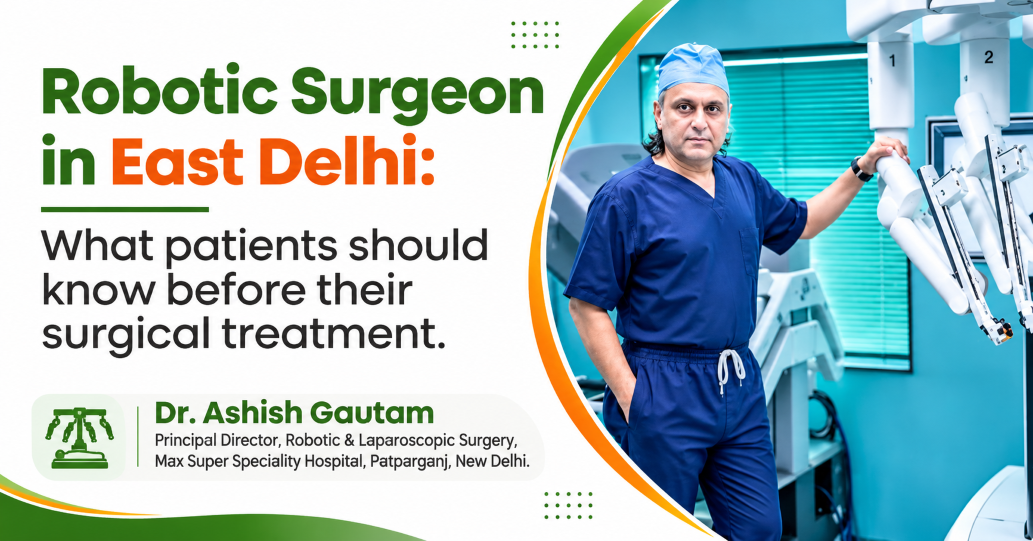
Dr. Ashish Gautam is Principal Director, Robotic & Laparoscopic Surgery, at Max Super Speciality Hospital, Patparganj, and Director of Dr. Gautam Health Care. A bariatric, robotic and laparoscopic surgeon, he has performed more than 30,000 surgeries over a career spanning more than three decades.
- Robotic expertise: Proctor for Intuitive Surgical’s da Vinci system, guiding other surgeons in robotic technique; robotic surgery training at the University of Sharjah, accredited by the Royal College of Surgeons of England.
- Qualifications: MBBS and MS (General Surgery) from S.N. Medical College, Agra; Fellow of the American College of Surgeons (FACS); Fellow in Advanced Laparoscopic Surgery (FALS); FIAGES.
- Experience: Senior residency at Maulana Azad Medical College and Lok Nayak Hospital, unit head of surgery at an NDMC tertiary referral hospital, and more than a decade heading a department of robotic, GI, bariatric and minimal access surgery in Ghaziabad.
- Areas of focus: Hernia, gallbladder, hiatal hernia and reflux, bariatric and metabolic, colorectal and hepatobiliary surgery.
- Memberships: Clinical Robotic Surgery Association, IFSO, Asia-Pacific Hernia Society, AMASI, OSSI and the Association of Surgeons of India.
Patients often describe his approach as unhurried and conversational: reports are reviewed in detail, options are explained plainly, and he stays closely involved through recovery.
Conclusion
Choosing a surgical treatment is not about picking the newest technology. It is about matching the right approach to your condition, and the right surgeon to that approach. Robotic surgery offers real advantages in selected, often complex, operations, while laparoscopic and open surgery remain the better fit for others.
If you are looking for a robotic surgeon in East Delhi, go to your consultation prepared, ask direct questions about experience and outcomes, and expect honest answers. A surgeon skilled in all three approaches is best placed to recommend the one that serves you.
FAQ’s
Not always. For routine operations such as uncomplicated gallbladder removal,
studies show broadly similar outcomes. The robotic approach tends to help most
in complex hernias, reflux surgery, bariatric revisions and pelvic or
hepatobiliary procedures.
No. The surgeon controls every movement from a console. The robotic system
translates the surgeon’s hand movements into precise instrument movements inside
the body.
Suitability depends on your condition, its complexity, previous surgery, overall
fitness for anaesthesia and your surgeon’s assessment. Not every patient will
benefit.
Look for experience in your specific procedure, formal robotic training,
proficiency in open and laparoscopic surgery, and a surgeon who explains risks
and alternatives clearly.
Many policies in India cover robotic procedures, sometimes with sub-limits.
Confirm cover with your insurer or TPA before admission.
It depends on the procedure. Many minimally invasive operations involve a short
stay, but your surgeon will give you a timeline based on your case.
At RDC, Sector 10, Raj Nagar, Ghaziabad. Call 098718 19918 to book an
appointment.

Dr. Ashish Gautam
MS, FACS (USA), FIAGES, FALS (GI Surgery),
FALS (Bariatric Surgery), FALS
(Colorectal Surgery)
Director - Gen, Laparoscopic & Robotic Surgery,
Max Super Speciality Hospital, Patparganj