Robotic Surgeon in Delhi NCR: Benefits, Procedures and How to Choose the Right Specialist
The search for a robotic surgeon in Delhi NCR usually begins after a diagnosis: a hernia, gallstones, a colorectal condition, reflux that medicines no longer control, or obesity-related health problems. A doctor may have suggested surgery, and you may have heard that a robotic-assisted approach is now available at several centres across Delhi, Noida and Ghaziabad.
This guide explains what robotic surgery is, how it works step by step, the procedures it is used for, who may be a suitable candidate, how it compares with laparoscopic and open surgery, and the risks worth discussing with your surgeon. It also covers how to choose the right robotic surgery specialist in Delhi NCR.
The information here is general and educational. Whether robotic surgery is right for you can only be decided after a personal evaluation by a qualified surgeon who has reviewed your symptoms, reports and overall health.
What Is Robotic Surgery?
Robotic surgery, also called robotic-assisted surgery, is a form of minimally invasive surgery in which the surgeon operates using specialised instruments mounted on robotic arms. Despite the name, the robot does not operate on its own. Every movement is controlled in real time by the surgeon, who sits at a console inside the operating theatre.
The system translates the surgeon’s hand movements into smaller, precise movements of the instruments inside the body. A high-definition 3D camera gives a magnified view of the operating area. The instruments have a “wrist” that can bend and rotate further than the human hand, which can help when working in confined spaces deep in the abdomen or pelvis.
Robotic surgery builds on laparoscopic (keyhole) surgery. Both use a few small incisions instead of one large cut. The difference lies in how the instruments are controlled and how the surgeon sees the operating field.
How Does Robotic Surgery Work?
The exact steps vary with the procedure, but the overall process usually follows this sequence:
- Consultation and evaluation. The surgeon reviews your symptoms, medical history, previous surgeries, current medicines, scans and blood tests. This decides whether surgery is needed and which approach suits you.
- Pre-operative preparation. You may need fitness tests such as blood work, an ECG, a chest X-ray and an anaesthesia check-up. You receive instructions on fasting, which medicines (such as blood thinners) to pause, and when to arrive.
- Anaesthesia and positioning. Robotic surgery is performed under general anaesthesia. You are positioned on the operating table to give the best access to the area being treated.
- Small incisions (ports). The surgeon makes a few small cuts, typically 5–12 mm each. The abdomen is gently inflated with carbon dioxide gas to create working space.
- Docking the robot. The robotic arms are brought to the table and connected to the ports, holding the camera and instruments.
- Surgery from the console. The surgeon controls the instruments using hand controls and foot pedals while viewing a magnified 3D image. A trained bedside team assists at the table throughout.
- Completion and closure. The instruments are removed, the gas is released, and the incisions are closed with stitches or skin glue.
- Recovery and follow-up. You are monitored as you wake up. Diet and walking are resumed as advised, and follow-up visits check wound healing and progress.
Benefits of Robotic Surgery
The benefits of robotic surgery depend on the procedure being performed and on each patient’s medical condition, age and overall health. No surgical technique can guarantee a particular outcome. In suitable patients, robotic-assisted surgery may offer:
- Smaller incisions than open surgery, which may mean smaller scars.
- A magnified 3D view that can help the surgeon identify tissue layers, blood vessels and nerves.
- Greater instrument dexterity in tight spaces such as the pelvis, the area around the food pipe, or near major blood vessels.
- Stable, tremor-filtered movements that support fine dissection and suturing.
- Potentially less pain and blood loss than open surgery for some operations.
- A shorter hospital stay and earlier return to routine activities for many patients, compared with open surgery.
Compared with conventional laparoscopic surgery, the advantages are more procedure-specific, and research continues to evaluate where they matter most. Your surgeon can explain what is realistic for your particular case.
Different Types of Robotic Surgery Procedures
Robotic assistance is used across many areas of general and gastrointestinal surgery. Below are eight procedures commonly discussed with a robotic surgery specialist in Delhi NCR.
1. Robotic Hernia Surgery
A hernia occurs when an organ or tissue pushes through a weak spot in the abdominal wall, for example in the groin (inguinal), at the navel (umbilical) or through an old surgical scar (incisional). In robotic hernia surgery, the surgeon returns the contents to their place and reinforces the weak area, usually with mesh, from inside the abdomen. It may be considered for large, recurrent or bilateral hernias and for abdominal wall reconstruction.
2. Robotic Gallbladder Surgery
Gallbladder removal (cholecystectomy) is commonly advised for gallstones that cause pain, gallbladder inflammation or certain polyps. Most cholecystectomies are performed laparoscopically with very good results. A robotic cholecystectomy may be considered in selected cases, such as difficult anatomy, a severely inflamed gallbladder or when another procedure is planned at the same time.
3. Robotic Colorectal Surgery
Robotic colorectal surgery treats conditions of the colon and rectum, including colorectal cancer, diverticular disease and rectal prolapse. The pelvis is deep and narrow, which can limit access. Wristed instruments and a magnified view may help the surgeon work precisely around the nerves that influence bladder and sexual function.
4. Robotic Bariatric Surgery
Bariatric (weight-loss and metabolic) surgery, such as sleeve gastrectomy and gastric bypass, may be considered for people with severe obesity, particularly when it is accompanied by type 2 diabetes, high blood pressure or sleep apnoea and other measures have not worked. Robotic bariatric surgery can assist with suturing and access in patients with a higher body mass. Long-term results depend heavily on diet, activity and regular follow-up.
5. Robotic Liver Surgery
Robotic liver surgery involves removing part of the liver (liver resection) to treat tumours, cysts or other lesions. Because the liver has a rich blood supply, a magnified view can help the surgeon identify vessels and bile ducts. Suitability depends on the size and location of the lesion and the health of the remaining liver.
6. Robotic Pancreatic Surgery
Pancreatic operations, such as distal pancreatectomy and, in selected cases, the Whipple procedure, are among the most complex abdominal surgeries. They are performed for tumours, cysts and some cases of chronic pancreatitis. Robotic pancreatic surgery may support the fine dissection and suturing these operations require, in carefully selected patients treated by experienced teams.
7. Robotic Hepatobiliary Surgery
Hepatobiliary surgery covers the liver, gallbladder and bile ducts. Beyond routine gallbladder removal, robotic hepatobiliary surgery may be used for bile duct stones, choledochal cysts, bile duct repair and some tumours of the biliary system. These procedures often need precise reconstruction of small ducts, where wristed instruments can be useful.
8. Robotic Fundoplication
Robotic fundoplication treats long-standing gastro-oesophageal reflux disease (GERD) and hiatal hernia when medicines and lifestyle changes have not controlled symptoms. The surgeon repairs the opening in the diaphragm and wraps the upper part of the stomach around the lower food pipe to strengthen the valve against reflux. Robotic assistance may help in the narrow space around the food pipe.
Who Is a Suitable Candidate for Robotic Surgery?
Suitability is decided case by case. You may be considered for a robotic-assisted procedure if:
- You have a condition that can be treated with minimally invasive surgery, such as a hernia, gallbladder disease, reflux, a colorectal condition or severe obesity.
- You are fit enough for general anaesthesia.
- Your operation involves a confined or hard-to-reach area where added precision may help.
- You have had a previous operation in the area and the surgeon considers a minimally invasive approach still feasible.
Robotic surgery may not be advisable, or may need extra evaluation, if you have severe heart or lung disease that limits tolerance of long anaesthesia or gas inflation, very dense scar tissue from multiple earlier operations, an uncorrected bleeding disorder, or an emergency where time is critical. In some patients, laparoscopic or open surgery is the safer choice.
Robotic Surgery vs Laparoscopic Surgery vs Open Surgery
| Factor | Robotic surgery | Laparoscopic surgery | Open surgery |
|---|---|---|---|
| Incisions | A few small cuts (about 5–12 mm) | A few small cuts | One larger cut |
| Surgeon’s view | Magnified 3D, camera controlled by the surgeon | Magnified, usually 2D, camera held by an assistant | Direct view |
| Instrument movement | Wristed, tremor-filtered | Straight, rigid instruments | Surgeon’s hands |
| Hospital stay | Often short; depends on procedure | Often short; depends on procedure | Usually longer |
| Recovery | Often quicker than open surgery | Often quicker than open surgery | Usually slower |
| Cost | Generally the highest | Moderate | Varies with procedure and stay |
| Often preferred for | Complex or confined-space operations | A wide range of routine operations | Emergencies, very large or complex disease, or where keyhole surgery isn’t feasible |
Robotic surgery is not automatically better than laparoscopic surgery. For many routine operations, such as a standard gallbladder removal, laparoscopic surgery already gives excellent results. The robot’s advantages tend to matter most in technically demanding procedures. The right choice depends on your diagnosis, anatomy, overall health and your surgeon’s experience with each technique.
Risks and Possible Complications of Robotic Surgery
Robotic surgery is still surgery, and every operation carries some risk. Possible complications include:
- Reactions or complications related to general anaesthesia
- Bleeding during or after the operation
- Infection at an incision site or inside the abdomen
- Injury to nearby organs, blood vessels, the bowel or the bladder
- Blood clots in the legs or lungs
- A hernia developing at a port site later
- Temporary bloating or shoulder-tip pain from the carbon dioxide gas
- The need to convert to laparoscopic or open surgery during the operation, if the surgeon judges it safer
- Rarely, technical issues with the equipment, which trained teams are prepared to manage
The level of risk depends on the procedure, your health and the experience of the surgical team. Ask your surgeon about the specific risks for your operation, and seek prompt medical attention after surgery if you notice fever, worsening pain, bleeding, breathlessness or persistent vomiting.
How to Choose the Best Robotic Surgeon in Delhi NCR?
The technology matters, but the surgeon matters more. When looking for the best robotic surgeon in Delhi NCR for your condition, consider:
- Qualifications and training. Look for a surgical postgraduate degree (MS or equivalent), recognised fellowships, and formal training in robotic surgery.
- Experience with your procedure. Ask how often the surgeon performs your specific operation, both robotically and laparoscopically.
- Range of techniques. A surgeon skilled in robotic, laparoscopic and open surgery can recommend the approach that suits you, rather than one method for every case.
- Hospital and team. Robotic surgery needs a trained theatre team, anaesthesia support and critical-care backup.
- Clear communication. You should come away understanding why surgery is advised, the alternatives, the risks, the expected recovery and the likely costs.
- Follow-up care. Check how post-operative visits and queries are handled.
- Accessibility. A consultation centre close to home makes pre-operative visits and follow-ups easier.
Why Consider Dr. Ashish Gautam for Robotic Surgery in Delhi NCR?
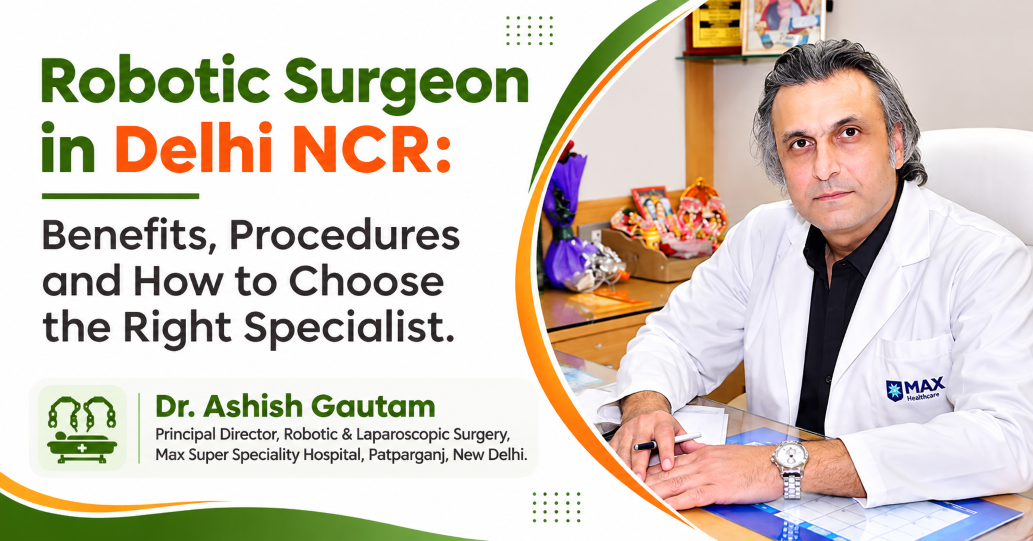
Dr. Ashish Gautam is Principal Director – Robotic & Laparoscopic Surgery, Max Hospital, New Delhi, and Director, Dr. Gautam Health Care. A bariatric, robotic and laparoscopic surgeon with 30,000+ surgeries to his credit, he is a Fellow of the American College of Surgeons (FACS) and a Proctor for Intuitive Surgical’s da Vinci robotic system, training other surgeons in robotic techniques. He consults patients at his centre at RDC, Raj Nagar, Ghaziabad, making specialist robotic surgery consultations accessible for patients across East Delhi, Ghaziabad, Noida and the wider NCR.
His training and experience include:
- 30,000+ surgeries performed across robotic, laparoscopic, bariatric and general surgery
- Proctor, Intuitive Surgical da Vinci robotic surgery system
- MBBS (1998) and MS in General Surgery (2003) from S.N. Medical College, Agra
- Senior residency in surgery, including laparoscopic surgery, at Maulana Azad Medical College and Lok Nayak Hospital, New Delhi (2004–2007)
- Robotic surgery training at the University of Sharjah, accredited by the Royal College of Surgeons of England (2022)
- Fellowships: FACS (Fellow of the American College of Surgeons), FALS (Advanced Laparoscopic Surgery) and FIAGES
- Over two decades of surgical practice, including more than 13 years heading a department of robotic, gastrointestinal, bariatric and minimal access surgery in Ghaziabad
- Memberships of the Clinical Robotic Surgery Association, IFSO, the Obesity and Metabolic Surgery Society of India, the Association of Minimal Access Surgeons of India, IAGES, the Hernia Society of India and the Asia-Pacific Hernia Society
His areas of focus include robotic hernia, gallbladder, fundoplication, colorectal, bariatric, liver, pancreatic and hepatobiliary surgery, alongside advanced laparoscopic surgery. As a robotic surgery specialist in Delhi NCR trained in robotic, laparoscopic and open techniques, he evaluates each patient individually and explains every suitable option, including when robotic surgery is not necessary.
What to Expect Before and After Robotic Surgery?
Before surgery
- A detailed consultation and review of your reports
- Fitness tests and an anaesthesia assessment
- Guidance on fasting, medicines to continue or pause, and stopping smoking
- A clear explanation of the procedure, the expected hospital stay and consent
After surgery
- Monitoring in the recovery area, then on the ward
- Walking early, often on the same or next day, to reduce the risk of clots
- Pain relief and a gradual return to fluids and food as advised
- Wound-care instructions and guidance on lifting, driving and returning to work
- Follow-up visits to check healing; for bariatric surgery, long-term diet and nutrition follow-up
Recovery time varies widely by procedure. A hernia or gallbladder operation and a pancreatic or liver resection have very different timelines, so ask your surgeon what to expect for your case.
Robotic Surgery Consultation in Delhi NCR
If you have been advised surgery, or want to know whether a minimally invasive or robotic-assisted approach suits your condition, you can book a consultation with Dr. Ashish Gautam at his Ghaziabad centre.
Please bring your previous reports, scans, prescriptions and a list of current medicines. Call ahead to confirm consultation timings before visiting.
Conclusion
Robotic surgery has expanded the options available to patients in Delhi NCR, offering a precise, minimally invasive approach for a growing range of procedures. It is not the right choice for every patient or every condition, and its benefits depend on the procedure and your health. The most important step is an honest, detailed evaluation by an experienced surgeon who can explain every suitable option. If you are looking for a robotic surgeon in Delhi NCR, a consultation with Dr. Ashish Gautam at RDC, Raj Nagar, Ghaziabad can help you understand your diagnosis and decide on the next step with confidence.
FAQs
The best robotic surgeon for you is one with the right training, experience in
your specific procedure, and skill across robotic, laparoscopic and open
techniques. Dr. Ashish Gautam, Principal Director – Robotic & Laparoscopic
Surgery, Max Hospital, New Delhi, and Director, Dr. Gautam Health Care, has
performed 30,000+ surgeries, is a Fellow of the American College of Surgeons
(FACS) and is a Proctor for Intuitive Surgical’s da Vinci system. He consults
patients at RDC, Raj Nagar, Ghaziabad.
It is a minimally invasive technique in which the surgeon operates through small
incisions using robotic instruments controlled from a console. The surgeon is in
control throughout; the system provides a magnified 3D view and precise
instrument movement.
Under general anaesthesia, the surgeon makes a few small incisions, places a
camera and instruments, and connects them to the robotic arms. The surgeon then
operates from a console, and the system translates hand movements into precise
instrument movements inside the body.
Not in every case. Both are minimally invasive. Robotic surgery may offer
advantages in complex or confined-space procedures, while laparoscopic surgery
gives excellent results for many routine operations. Your surgeon will recommend
the approach that suits your condition.
Robotic surgery is an established technique when performed by trained surgeons
in equipped hospitals. Like any surgery, it carries risks such as bleeding,
infection and anaesthesia-related complications. Your surgeon should discuss the
specific risks of your procedure with you before surgery.

Dr. Ashish Gautam
MS, FACS (USA), FIAGES, FALS (GI Surgery),
FALS (Bariatric Surgery), FALS
(Colorectal Surgery)
Director - Gen, Laparoscopic & Robotic Surgery,
Max Super Speciality Hospital, Patparganj